Whop vs Shopify: Which Fits a Digital Business?
I get a version of this question almost every week now, and it usually arrives slightly embarrassed. Someone has built something real — a community, a course, a piece of software, a library of files people pay to download — and they’ve hit the point where they need to take money properly. So they go looking, and they find themselves staring at two tabs, trying to work out which one they’re supposed to want.
Before I answer it, one thing has to be said plainly, because the internet is sloppy about it: Whop is not Shopify, and Whop is not a Shopify processor. They are separate companies building differently shaped tools. Whatever else you take from this, don’t leave thinking one is a version of the other.
And I’m going to be deliberately careful about a second thing. I’m not going to tell you what either platform charges, what either one does or doesn’t support, or which has the better dashboard. Not because I’m being coy — because that kind of detail changes constantly, and a comparison table written today is a liability by next quarter. Anyone confidently reciting feature lists to you about a platform they don’t work for is guessing. Check the current specifics with each platform directly, always.
What I can give you is the thing that doesn’t change: how to tell which shape of business you’re running. Because that’s the actual decision, and once you see it, the rest gets a lot less confusing.
“Versus” is the wrong word
The framing everyone arrives with is that these two things are competitors, and that one of them must be the better product. That’s not really what’s going on. It’s closer to asking whether a van is better than a workshop. Both are useful. They’re answers to different questions.
Every payment tool is built around an assumption about what a sale is. Get that assumption to match your business and everything downstream feels easy. Get it wrong and you spend eighteen months building workarounds for a shape the tool was never meant to hold.
The dividing line: does the sale end?
Here’s the question I ask, and it takes about four seconds to answer:
When someone pays you, is that the end of the transaction — or the beginning of a relationship you have to keep enforcing?
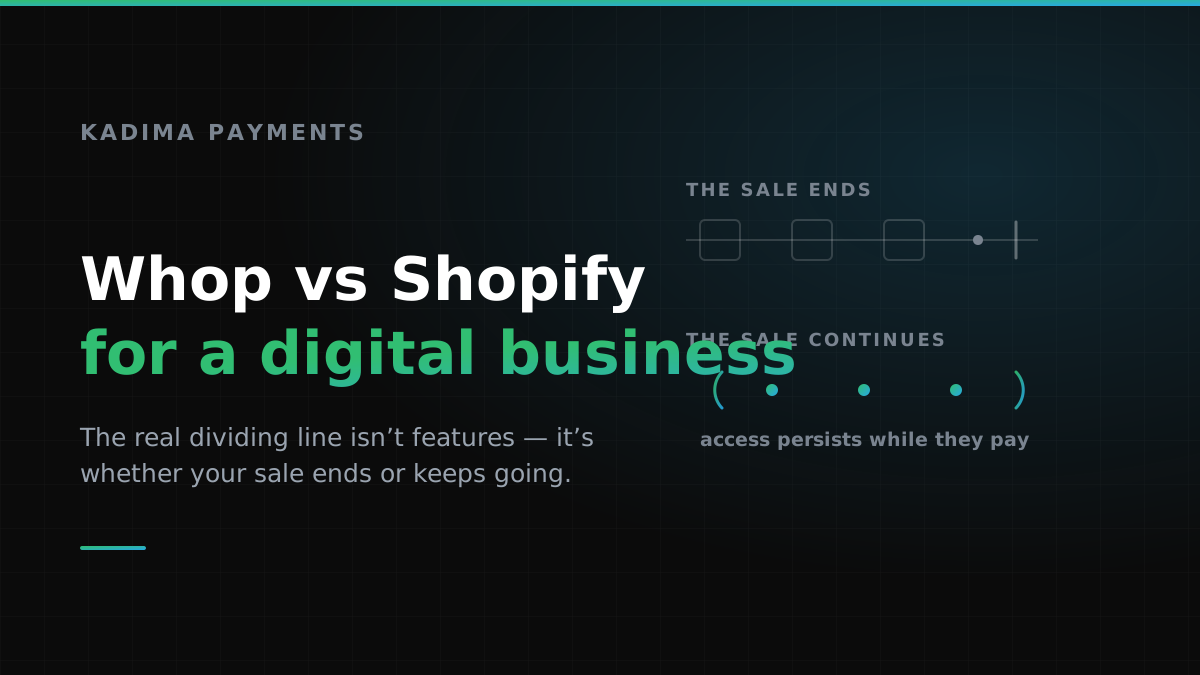
Storefront commerce, the world Shopify was built around, assumes the sale ends. An order gets placed, the order gets fulfilled, and the transaction closes. There’s a cart, there’s a checkout, there’s something that goes out the door. Even when a storefront sells a subscription, the mental model underneath is still an order being placed repeatedly.
Access-based commerce, the world Whop is built around, assumes the sale doesn’t end. Somebody pays, and now they’re in. They stay in as long as they keep paying. The instant they stop, they need to be out — and that removal has to happen on its own, because if a human being has to remember to do it, it will not happen. What you sold isn’t an object. It’s a state.
That difference sounds philosophical. It is extremely practical.
What that actually looks like on a Tuesday
If your sale ends, your operational problems are logistics problems. Inventory, shipping, returns, an address that has to be right, a customer who wants to know where the package is. Your worst day is a fulfilment failure.
If your sale doesn’t end, none of those exist. You have no warehouse, no shipping, no returns in the normal sense. What you have instead is an entitlement problem. Who currently has access? Who lapsed on Thursday and is still in the group? Who upgraded, who downgraded, who charged back three weeks ago and is still enjoying everything they charged back? Your worst day is discovering that a meaningful slice of the people inside your product stopped paying for it a while ago and nobody noticed.
I’ve watched people run the second business inside tooling designed for the first. It works, right up until it doesn’t. Usually the failure isn’t dramatic — it’s a slow leak, discovered late, where the revenue was never actually being collected the way anyone assumed.
So: if what you sell is a download, a login, a private group, a cohort, a licence, a membership — something where the value is continuing access — you are in access-based commerce, and you should be looking at tools built for it. That’s the honest case for a platform like Whop, and it has nothing to do with any feature list.
The second decision, which nobody separates from the first
This is the part I care most about, because it’s where I see expensive mistakes, and it’s the bit no platform comparison article ever tells you.
Choosing where you sell and choosing how you get paid are two different decisions. People collapse them into one and then can’t understand why, two years later, they feel stuck.
When you sell through a platform, you are generally operating under that platform’s payments arrangement. That is a completely reasonable trade early on — you get to launch without assembling anything, and speed genuinely matters more than optimisation when you’re still finding out whether the thing works at all. I’d make that trade myself.
But understand what you’re trading. On a platform, the processing relationship isn’t yours. The underwriting isn’t yours. The decision about whether your account continues isn’t yours, and it isn’t mine either — on Whop, availability, verification, pricing, payment capabilities and approval are all determined by Whop. I have no say in it and neither will any agent who tells you otherwise.
A dedicated merchant account is the opposite arrangement. You get your own merchant ID, your own underwriting relationship, and terms that were written down before you processed a dollar rather than reassessed after a good month. That’s the whole reason we do what we do: risk defined at the front, so growth doesn’t read as an anomaly to somebody’s model.
When you want your own account instead
Being straight with you, because it costs me nothing to be: plenty of the people reading this shouldn’t be on a platform at all. Here’s when I’d point you at your own merchant account.
You ship physical things. Once there’s a warehouse and an address, you’re in storefront commerce, and a lot of the access-based tooling stops earning its keep. Our e-commerce payments page is written for exactly that business.
You also sell in person. The moment a card gets tapped at a counter, you want card-present and card-not-present sitting on one account with one settlement story, not two disconnected systems and a bookkeeper reconciling by hand.
The rate difference has started to compound. There’s a volume at which basis points stop being an abstraction and start being a hire. You’ll feel that number arrive. When it does, owning the processing relationship pays for the effort of setting it up.
Payments have to live inside your own systems. Your site, your app, your POS, your ERP, your internal tooling. Once payments need to be a component in something you control, you want a direct relationship and real integration surface — not whatever a platform chooses to expose.
You operate somewhere that needs deliberate underwriting. Regulated and specialty verticals don’t do well inside systems built to approve everyone quickly and sort it out afterwards. They do well when a human being who understands the category looks at the business first. That’s a conversation, not a signup form.
Most people should run both
The answer I give most often isn’t one or the other. It’s both, on purpose.
A business with a digital line and a physical line has no reason to force them through the same rails. Run the community, the course, the membership on a platform built for access. Run the core revenue — the shipped product, the in-person sales, the invoicing — on your own merchant account. Two tools, each doing what it’s shaped for.
The businesses that end up in a mess aren’t the ones that use both. They’re the ones that drifted into using both without deciding to — a platform picked up for one experiment, quietly load-bearing three years later, with nobody quite sure which revenue lands where or how any of it reconciles. Setting the split up deliberately, early, costs you an afternoon. Untangling it later costs considerably more.
That afternoon is one we’ll happily spend with you. Deciding which line of revenue sits on which rail is exactly the conversation we have with merchants every week, and it’s a lot cheaper to have it now than to reverse-engineer it out of a year of statements later.
A ten-minute way to decide
If you want to shortcut all of this, answer four questions honestly.
Does anything physical leave a building? If yes, you’re storefront-shaped, and you want a merchant account underneath whatever you sell through.
Does someone need to lose access when they stop paying? If yes, you’re access-shaped, and you want tooling that enforces that without you thinking about it.
Do payments need to appear inside software you control? If yes, you want your own account and a real integration — a platform’s arrangement will eventually become the constraint.
Would losing your ability to process on 24 hours’ notice end you? If yes, own the relationship. Not because platforms are reckless, but because the decision should sit with someone who has met you.
Most people find three of the four point the same direction. When they don’t, that’s usually the signal you’re genuinely a two-rail business.
What I’d tell you on the phone
If you called me and described a paid Discord with four hundred members and no physical product, I would not try to sell you a merchant account. It isn’t what you need yet, and I’d rather tell you that than board you into something you’ll resent. I’d point you at the Whop route, tell you what to keep an eye on, and ask you to come back to me the day access stops being the whole business.
If you described a supplement brand shipping two thousand orders a month and taking phone payments, I’d tell you a platform is going to fight you — and that this is squarely what we do. We’d build the account around how you actually sell, online and on the phone, on one settlement story.
And if you described both — which is more common than people expect — I’d tell you to run both, and then sit down with you and decide which revenue goes where, before your accountant discovers the answer on your behalf.
That’s the whole thing. Not a feature war. A question about what shape your business actually is, asked before you build on top of the wrong assumption.
One disclosure, plainly
Kadima Payments may receive compensation from qualifying Whop referrals. It doesn’t change what you pay, and it doesn’t change the advice — if a dedicated merchant account is the better fit for your business, I’ll tell you so, as I just did twice above. Whop is not a Kadima integration and we don’t process payments on Whop’s behalf; account availability, verification, pricing, payment capabilities and approval on Whop are determined by Whop. For anything specific about either platform, check with that platform directly rather than taking my word or anyone else’s.
You don’t have to pick alone
Here’s the part I actually want you to leave with.
Every route in this article is one we can put in front of you. A dedicated merchant account for online, for in person, or for both on one account. Recurring billing and stored credentials for subscription businesses. Invoicing and receivables through RapidPayLink. Payments wired into the software you already run. Deliberate underwriting for verticals that need a human to look first. And for digital-first businesses, the Whop route.
That matters more than it sounds, because most people advising you on this only sell one of those things — so you get the answer their product is able to give. We’d rather map the whole thing with you: work out what shape your business is, put the right route under each line of revenue, and change it when you outgrow the first answer. That last part is the one people forget. This isn’t a decision you make once. The business that belonged on a platform at four hundred members is a different business at four thousand, and somebody should be watching for the moment it changes.
So you don’t need to arrive with the answer. Bring us the business — what you sell, how it gets delivered, where you want it in two years — and we’ll walk the options through together and tell you which one we’d put you on and why. If that turns out to be a platform rather than us today, you’ll leave knowing exactly what has to be true before you move — and we’ll be here when it is.
Either way, you stop guessing. Talk to us and let’s work out where your revenue should actually run.
Let’s move forward.
Let’s work out which route fits — together.
Merchant accounts for online and in person, recurring billing, invoicing, integrations into your own stack, and the Whop route for digital-first businesses. We hold all of it, so the advice isn’t limited to one product. Tell us how your business actually sells and we’ll map it with you.